Communities of Change:
Advancing mammal ecology while empowering STEM learners
My research program is broadly designed to support environmental stewardship through novel understandings of biotic responses and advancement of scientific literacy. I investigate patterns of mammal responses to climatic and environmental changes by integrating ecology, biogeography, and paleontology to generate a more complete temporal and spatial understanding of ecosystems, their evolution, their functions, and the services they provide and to support informed predictions about the future of biodiversity. Much of my work focuses on large mammals (e.g., ungulates and carnivores), which are being affected by climate change and habitat loss at a startling rate. My goal is to contribute to the capacity of management and conservation efforts; yet the communication of scientific knowledge to the public has been inadequate. Therefore, I also explore the role of informal STEM learning institutions in public understanding of science by merging quantitative and qualitative data to facilitate place-based learning opportunities designed around ongoing research.
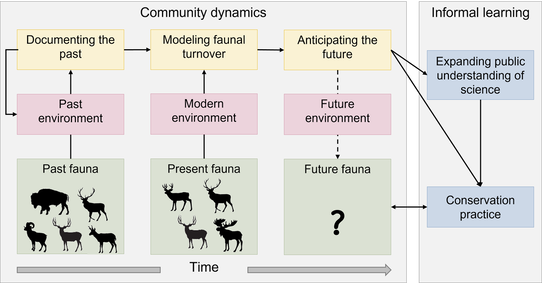
Research Framework
My research exists in four foci:
- Quantifying alignment of mammalian community-level functional traits with the environment – Functional traits, such as skeletal or dental morphologies, can be used as a measure of ecosystem function when traits are aligned with or diverged from what is expected based on the environmental conditions. My work on these trait-environment relationships relies on innovative quantitative models and large datasets from museum collections, climate records, and faunal occurrence records across temporal and spatial scales. I have largely focused on the calcaneal morphology (i.e., ankle bone shape) of artiodactyl (i.e., even-toed hoofed mammals) communities and the relationship with ecoregion, vegetation cover, and precipitation (Short and Lawing, 2021, Divers. and Distrib.). Across six sites in Kenya, this model captured homogenization in faunal communities and precipitation across the country over the past 100 years, which is supported by work from other researchers.
- Refining knowledge of the fossil record and environmental change – Integration of fossil and modern faunal data requires a clear understanding of the paleontological record. A long-term collaboration studies the mammalian fauna and paleoenvironment from San Clemente de Térapa, Sonora, Mexico (~40,000 years old). This site served as a point of faunal exchange during the late Pleistocene and preserved both temperate and tropical taxa. My work on the mammals at Térapa documented a shift in diet and a decrease in body mass in an increasingly xeric landscape (Short et al., 2021, Quat. Res.). Additionally, I have named four new mammalian species from the North American fossil record: a rhinoceros from Tennessee (Short et al., 2019, Bull. Florida Mus. Nat. Hist.) and three procyonids (i.e., raccoons and relatives) from Florida (Emmert and Short, 2018, Bull. Florida Mus. Nat. Hist.).
- Investigating how mammal communities respond to environmental change and anthropogenic pressures – I am leading a project to understand how anthropogenic pressures, such as land use and fragmentation, affect faunal communities, their traits, and their relationships with their habitats across trophic levels. I have integrated my existing model of artiodactyl trait-environment relationships with carnivoran data to generate a more complete community analysis that highlights geographic areas of functional disruption. I am also contributing to a project that uses trait-environment relationships across spatial, temporal, and taxonomic scales to explore ecosystem function in East Africa. Fossil records provide the long-term records to identify when, where, and in what way did humans impact the fauna.
- Enabling informal learning institutions to contribute to environmental stewardship – I contributed to research that resulted in a novel place-based informal learning framework (Struminger et al., 2018, BioScience) as well as studies of learner experiences at biological field stations (Struminger et al., 2021, BioScience; Zarestky et al., 2021, Adult Educ. Q.). With two undergraduate students, I investigated the spatial distribution of informal learning institutions (e.g., museums, zoos, libraries) and the relationship with population density and poverty (Short et al., 2020, Sci. Adv.). In doing so, we identified geographic gaps with few or no informal learning opportunities and found that these underserved areas have larger populations of Indigenous groups than non-underserved areas.
